

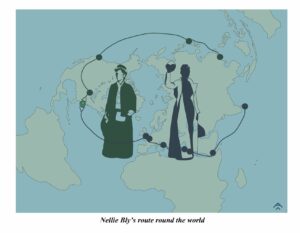
Would you believe that in the 1880’s two ladies really did!
It was all because of Jules Verne’s novel Around the world in 80 days. Of course, he wrote it in 1872, when they didn’t have air travel, which allowed him to write his famous book.
As always happens someone wanted to see if it could be done, and, that someone was, would you believe it, a woman, from Pittsburgh. Yes, a woman. But amazingly she wasn’t the only one!
This lady was Elizabeth Cochrane Seaman, who we know as Nellie Bly.
She was an exceptional journalist who began her career at the Pittsburgh Dispatch where her editor gave her the pen name, Nellie Bly. Why did he pick Nellie Bly, well, he took it from a song that was popular at the time by Stephen Forster, called “Nelly Bly”.
 Elizabeth was a lady who chased exciting journalism, it was for this reason that she moved to New York, where she talked her way into the editorial offices of the New York World, and undertook an undercover assignment. This was one of the farfetched things she was known for, would you believe that she decided to fake insanity! All to allow her to investigate rumours of brutality and neglect at the Women’s Lunatic Asylum on Blackwell’s Island, now called Roosevelt Island. She even learnt how to get committed to the asylum, once there she experienced the deplorable conditions first hand. It was ten days before her editor then got her released from the asylum.
The article she wrote of her experiences was published on October 9, 1887, and then later she wrote it up in a book titled Ten Days in a Mad-House. The result was that she became a sensation, and consequently prompted the asylum to implement reforms, which, of course, brought her lasting fame.
However, she was still bored, she needed more excitement, she needed to test herself again, so she started looking for another challenge. She found it when reading Jules Verne’s, Around the World in Eighty Days, this got her wondering as to whether it could in real life be achieved. She decided she wanted to see whether it was possible for her to physically go around the world in 80 days.
Obviously, to do this she needed a sponsor, which meant that once again she started badgering her editor at The New York World to let her do it, poor man. He loved the idea. However, even though he thought it would be a great story, he didn’t think it was a trip that a woman should do alone! She wouldn’t accept that a woman couldn’t do it, so she continued to badger him for a year, in the end he had to relent.
Within 48 hours of him saying “yes”, she, on November 14, 1889, boarded The Augusta Victoria, a steamer of the Hamburg America Line.
As I said earlier, she wasn’t the first person to go around the world, as a few years before, in 1872, Thomas Cook, of the travel agency fame, had gone on a journey around the world, but he took seven months and recorded it in several letters, which we think she read. Interestingly it was those letters that prompted Jules Verne to write the original book, Around the World in Eighty Days.
The next extraordinary thing about this story is what she decided to take with her, as she was determined to travel light, and would you believe that this was all she took:
- a single dress, which she wore all the time, of course!
- underwear, several pieces, she felt essential!
- a heavy coat, necessary!
- a small bag, for her bits.
- $200 and some gold coins, hidden in a bag tied around her neck.
Now this is where it gets interesting as she wasn’t the only woman going round the world at this time.
 You see, in those days there was furious competition between two New York newspapers The New York World and The Cosmopolitan. This meant that when John Brisben Walker, owner of The Cosmopolitan, heard what Nellie was doing, he immediately announced a challenge. He told one of his female journalists at The Cosmopolitan that they were going round the world, and they had to beat Nellie Bly! The lucky journalist was, Elizabeth Bisland, who was instructed to go around the world and that she had to do it quicker than Nellie, only this time there was a catch, she would go round the other way!
So, in 1889 there were two women going around the world, each in a different direction at the same time!
Of course, not to be outdone and to get even more publicity, The New York World, decided to run a “Nellie Bly Guessing Match” asking readers to guess Bly’s arrival time back in New York. The Grand Prize being a free trip to Europe, while by means of the telegraph, she would send regular updates to help readers decide on her arrival date.
She had planned the trip very meticulously, she had had the time while she was working on her editor. She cleverly decided to use a variety of different forms of transport as she worked out the quickest way to get around the globe.
Therefore, once she was given the go, she already knew the fastest routes and most useful ports and even the stations to use. For most of the route she decided to travel on steamships, but she also chose a variety of different types of transport. The articles she sent back tell of a variety of vehicles, such as steam trains, ferries, rickshaws, horses and even donkeys.
To start with she didn’t enjoy it at all, you see, she soon learnt that she suffered seasickness! Thankfully, she finally arrived on dry land in England, once she had disembarked, she took the first train to London and then another down to the Channel, where she took the Packet steamer to France and then on to Paris. However, before she reached Paris, there was something she couldn’t resist, she stopped off at Amiens to meet Jules Verne. He, she reported, wished her the best of luck saying, “If you do it in seventy-nine days, I shall applaud with both hands.”
She now went on to use the rail networks across Europe as she journeyed through France, and then all the way down to the foot of Italy, where she finally reached the port of Brindisi. Yes, now she had to go by ship, fortunately it appears that she had finally got her sea legs.
It was here that she boarded a steamship going first to Egypt, then through the Suez Canal and down the Red Sea to Aden. In Aden she switched to another vessel to take her across the Indian Ocean to Colombo in Sri Lanka, which then took her on to Penang, Singapore, and finally to Hong Kong.
Her stay in Hong Kong was interesting for two reasons, as it was where she first learnt that she was in competition with Elizabeth Bisland, and while waiting for her next ship she decided to visit a leper colony, something that was so typical of her.
Nelly finally left Hong Kong aboard a liner to Yokohama in Japan, a town near Tokyo. It appears from her reports we learn that she fell in love with it and its people. In her dispatch from there she said, “I found nothing but what delighted the finer senses while in Japan”.
She was now on her final stage, another sea voyage! Unfortunately for her, this time the Pacific was a bit rough, in fact, it was very rough, which meant that she arrived in San Francisco two days behind schedule, where when she finally arrived, she was welcomed as a star. Fortunately, The New York World owner, Pulitzer, chartered a private train to bring her home to New York.
Then, on January 25, 1890, at 3:51 pm, she returned to New York, 72 days 6 hours, 11 minutes and 14 seconds after she departed, and she had done the whole trip alone! In the meantime, her competitor Elizabeth Bisland was still on a ship crossing the Atlantic, she arrived four days later.
Isn’t it interesting that these two women, both went around the world in less than 80 days.
However, at the time there was another world traveller, George Train, in fact, he did his first world tour over a period of two years, then in 1870 he went around in 80 days. This, it is claimed, is where Jules Verne got the idea for his book title. More importantly, George knew he could have done it quicker, this is because would you believe it, when he reached Paris, he got involved in the Paris Commune. As a result, he had to spent two weeks in a French jail!
Once the two ladies had returned in 1890, he decided to return to world travel and show that he could do it quicker. He did, he went, he did it in 67 days, beating Nellie Bly’s record time, then would you believe he was persuaded to go again and finally did it in just 60 days!
How many days could you do it today if you didn’t use air travel?
That is the fun of History!
10 questions to discuss:
- How did Nellie Bly’s journey around the world in 1889 challenge societal norms of the time?
- What were some of the key items Nellie Bly packed for her journey, and why were they essential for her travels?
- What motivated Nellie Bly to undertake such a daring and groundbreaking adventure?
- How did Nellie Bly utilize her journalistic skills and the technology of the time (such as the telegraph) to document her journey?
- What obstacles did Nellie Bly face during her journey, and how did she overcome them?
- What was the significance of the competition initiated by The New York World, the “Nellie Bly Guessing Match,” during her trip?
- How did Nellie Bly’s journey inspire other journalists and adventurers of her time?
- What impact did Nellie Bly’s trip have on the field of journalism and the public’s perception of women in that profession?
- How did Nellie Bly’s journey compare to that of her competitor, Elizabeth Bisland, who traveled in the opposite direction?
- Reflecting on Nellie Bly’s journey, what lessons can we learn about determination, perseverance, and pushing the boundaries of what is considered possible?
There is a lot more on Nellie Bly at these sites:
https://www.womenshistory.org/education-resources/biographies/nellie-bly-0
https://www.biography.com/authors-writers/nellie-bly
https://wams.nyhistory.org/modernizing-america/modern-womanhood/nellie-bly/
© Tony Dalton